
You’re likely no stranger to the frustration of trying to communicate in noisy environments if you’re living with hearing loss. Background noise can quickly overwhelm and obscure speech, making conversations a chore. But there’s good news: modern hearing aids are equipped with advanced noise reduction features designed to tackle this very issue. By leveraging technologies such as digital noise reduction and directional microphones, these devices can notably enhance your ability to hear and understand in challenging situations. This could be the key to transforming your social interactions and daily life, but how exactly do these features work?
Key Takeaways
- Digital Noise Reduction (DNR) enhances speech understanding in noisy environments by filtering out background noise to focus on conversations.
- Modulation-Based Systems analyze speech and noise levels to improve speech clarity by distinguishing between speech and ambient noise.
- Spectral Subtraction Techniques identify and subtract unwanted noise from desired speech signals by analyzing the frequency spectrum.
- Directional Microphones capture sound from specific directions, reducing noise from non-target sources and improving speech clarity and sound localization.
- Adaptive Algorithms minimize distractions from wind and traffic, constantly improving listening experiences in various settings.
Digital Noise Reduction Overview
Digital Noise Reduction (DNR) is a technology integrated into hearing aids to enhance speech understanding in noisy environments. It helps you focus on conversations and filter out background noise, like a superhero cape for your ears. DNR works by analyzing the sound signals and adjusting the gain and output to reduce the noise. This technology is super handy, especially in places like restaurants or shopping malls where background noise can be overwhelming. Furthermore, DNR can dynamically adapt using artificial intelligence, making the listening experience more natural and less fatiguing. Some advanced systems even utilize directional microphones to further enhance sound quality.
Now, you might be wondering how DNR affects user experience. Well, studies have shown that DNR can greatly improve speech understanding in noisy environments, which means you can enjoy your favorite coffee shop without straining to hear your friends. Additionally, DNR algorithms can be programmed to suit individual user preferences, so you can customize your hearing aid to fit your lifestyle. For example, some DNR algorithms can reduce noise more aggressively, while others can preserve more of the original sound. It’s like having a personal sound engineer in your ear.
Historical Development of Noise Reduction
The concept of noise reduction in hearing aids has a history that dates back to the 1970s. You might be thinking, “Wow, that’s a long time ago!” And you’re right, it is. But back then, noise reduction was more like a lone cowboy trying to tame the wild west – it was a bit of a wild card. The first attempts at noise reduction involved simple filters and tone switches, which were basically like using a band-aid on a bullet wound. They didn’t quite hit the mark. It was during this period that the first rudimentary noise masking strategies were employed, aiming to obscure unwanted sounds with more pleasant ones.
Fast forward to the 1980s, and things started to get more interesting. Technological advancements like digital signal processing (DSP) came onto the scene, allowing for more sophisticated noise reduction techniques. This was like bringing in the cavalry – it was a game-changer. Suddenly, hearing aids could do more than just amplify sound; they could actually help reduce background noise. This was a major milestone in the history of noise reduction, and it paved the way for even more innovative technologies to come. So, buckle up and get ready to explore the wild west of noise reduction.
Types of Noise Reduction Algorithms
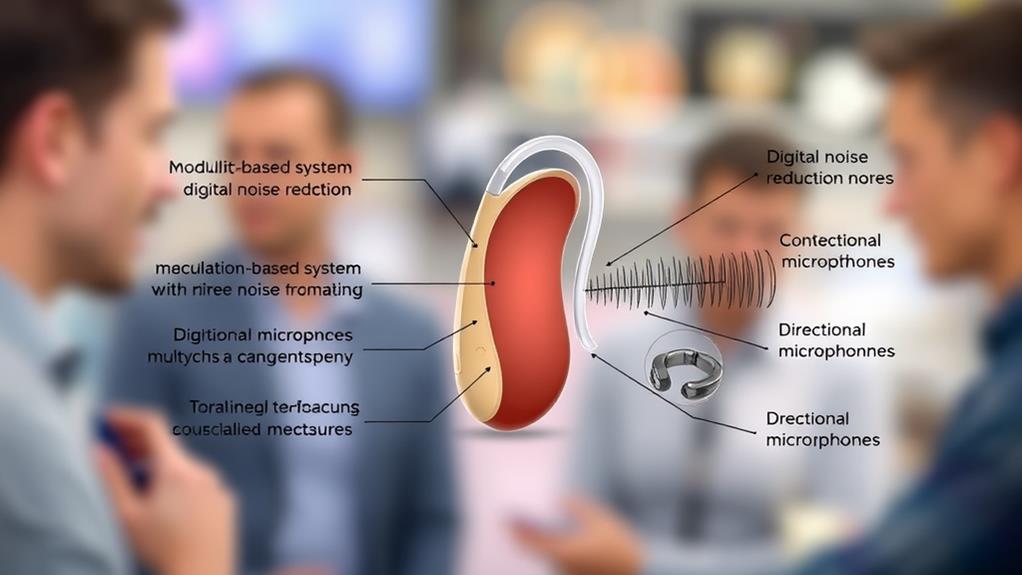
You’re probably wondering how hearing aids actually reduce background noise. Well, it’s all about the algorithms – think of them as super-smart formulas that help your hearing aids decide what sounds to keep and what to ditch. There are several types of noise reduction algorithms, including modulation-based systems that analyze speech and noise levels, and spectral subtraction techniques that separate speech from background noise, making it easier for you to hear what matters.
Algorithm Types and Functions
Noise reduction algorithms are essential components of hearing aid advancements, as they help improve speech intelligibility by rejecting unwanted noise signals. These algorithms are designed to enhance your user experience by reducing background noise, making it easier for you to understand conversations in noisy environments. For instance, they work alongside directional microphones to provide a clearer listening experience. Imagine you’re at a bustling restaurant, trying to catch up with friends. Without noise reduction, it can be tough to make out what they’re saying over the clinking dishes and chatter. But with these algorithms, your hearing aids can differentiate between speech and noise, turning down the volume of background sounds and amplifying speech.
There are several types of noise reduction algorithms used in hearing aids, including modulation-based systems and impulse noise reduction. Modulation-based systems analyze the differences between speech and noise signals, adjusting the output accordingly. Impulse noise reduction, on the other hand, softens sudden, loud noises like rattling dishes or typing on a keyboard. By incorporating these algorithms, hearing aids can greatly improve your ability to communicate effectively in noisy situations.
Noise Reduction Techniques
Understanding the different types of noise reduction algorithms is key to selecting the best hearing aids for your needs. You’re probably wondering how these algorithms actually work to reduce background noise and improve sound quality. Well, let’s explore the specifics.
Noise reduction techniques in hearing aids are designed to isolate sound and filter out background noise. There are several types of algorithms, each with its own strengths and weaknesses.
| Algorithm Type | How it Works | Benefits |
|---|---|---|
| Modulation-based | Analyzes speech and noise levels to adjust gain | Improves speech clarity in noise |
| Spectral Subtraction | Reduces noise by subtracting it from the overall signal | Effective in reducing constant background noise |
| Adaptive Filtering | Automatically adjusts filter settings based on noise levels | Provides real-time noise reduction |
| Artificial Intelligence | Uses machine learning to adapt to different sound environments | Offers personalized noise reduction |
These algorithms work together to provide effective noise reduction and sound isolation. By understanding how they work, you can choose the right hearing aids for your needs and enjoy better sound quality in noisy environments.
Signal Processing Methods
Several types of noise reduction algorithms are employed in hearing aids to effectively isolate sound and filter out background noise. You see, these algorithms are like superheroes, saving the day by making sure you can hear what’s important and not get overwhelmed by the background chatter. They’re pretty cool, and you should know about them.
Adaptive algorithms are a big deal in hearing aids. They adjust to the noise levels in your environment, making sure you can hear what you need to. For example, if you’re in a noisy restaurant, the algorithm will help filter out the background noise so you can focus on your conversation. Environmental factors like wind, traffic, and construction can also be minimized with these algorithms.
These noise reduction algorithms are like having a personal sound engineer, making sure you can hear what you need to, no matter where you are. They’re constantly working to improve your listening experience, so you can focus on what matters. With the right hearing aid and noise reduction algorithm, you’ll be able to hear the world in a whole new way.
Modulation-Based Noise Reduction
You’re probably wondering how modulation-based noise reduction works. It’s actually pretty simple: this technology analyzes sound waves to differentiate between speech and ambient noise, then reduces the volume of that background noise so you can hear conversations more clearly. By doing so, it markedly improves speech clarity, making it easier for you to understand what’s being said in noisy environments.
How It Works
Modulation-based noise reduction in hearing aids relies on advanced algorithms that differentiate between speech and noise based on their temporal characteristics. This technology aims to enhance user experience and satisfaction by reducing background noise, making it easier for you to focus on the sounds that matter.
Here are some key aspects of how modulation-based noise reduction works:
- Temporal Analysis: The algorithm analyzes the temporal characteristics of incoming sounds to distinguish between speech and noise. Speech typically has modulations in the 3 Hz range, while noise has higher frequency modulations.
- Channel-Specific Gain Reduction: If a channel is primarily noise, the algorithm reduces the gain in that channel to minimize the noise.
- Gradual Onset Time: The algorithm takes a few seconds (around 5-7 seconds) to reach maximum gain reduction, ensuring smooth changes.
- Adaptive Processing: The system continuously adapts to changing sound environments to optimize noise reduction and speech intelligibility.
These features work together to provide a more comfortable and effective listening experience, especially in noisy situations.
Reducing Ambient Noise
Halving the volume of background noise, modulation-based noise reduction in hearing aids enhances user experience and satisfaction, particularly in noisy environments. Imagine you’re at a bustling restaurant trying to catch up with friends, but the background noise is overwhelming. That’s where modulation-based noise reduction comes in – it’s like having your own personal sound engineer who adjusts the volume to make conversations clearer.
This technology analyzes the sound environment and detects the differences between speech and noise. When it identifies loud noise, it automatically lowers the volume, making it easier for you to focus on the conversation. It’s not just about turning down the volume; it’s about creating a more comfortable listening experience. For example, if you’re in a busy street, the noise reduction system will adjust itself at different frequency bands, turning down the frequencies with loud noises and turning up the frequencies that represent speech. This way, you can communicate effectively without straining to hear. It’s like having a superpower that helps you tune in to what matters most – the conversation.
Improving Speech Clarity
Modulation-based noise reduction in hearing aids not only reduces ambient noise but also plays a significant role in improving speech clarity. This technology is designed to differentiate speech from noise based on temporal characteristics, such as the modulation patterns of speech signals.
Key Points for Improving Speech Clarity with Modulation-Based Noise Reduction:
- Speech Recognition: Modulation-based noise reduction enhances speech recognition by reducing the impact of background noise on speech signals.
- Auditory Perception: By focusing on the temporal characteristics of speech, these algorithms help your auditory system better distinguish between speech and noise.
- Noise Reduction: Modulation-based noise reduction reduces the overall noise level, making it easier to understand speech in noisy environments.
- Customization: Different manufacturers offer various modulation-based algorithms, so it’s important to find the one that best suits your hearing needs.
Modulation-based noise reduction is a powerful tool for improving speech clarity in hearing aids. By leveraging the unique temporal characteristics of speech, these algorithms help you hear more clearly and comfortably, even in noisy environments.
Spectral Subtraction Techniques

Spectral subtraction techniques play an essential role in reducing noise in hearing aids. You might be wondering how these techniques work. Well, they involve identifying and subtracting unwanted noise from the desired speech signal. This is done by analyzing the frequency spectrum of the noisy signal and estimating the noise spectrum, a process known as spectral estimation. Once the noise spectrum is estimated, it can be subtracted from the noisy signal to obtain a cleaner speech signal.
But here’s the thing: spectral subtraction can be a bit tricky. If the noise spectrum is not accurately estimated, it can lead to noise masking, where the desired speech signal is also affected. To avoid this, hearing aids use various algorithms to dynamically estimate the noise spectrum and adjust the gain accordingly. These algorithms are designed to reduce noise in specific frequency regions, while preserving the speech signal. By using spectral subtraction techniques, hearing aids can considerably improve speech clarity and reduce noise, making it easier for you to hear what matters.
Adaptive Filtering in Hearing Aids
Adaptive filtering in hearing aids is an essential technology designed to dynamically reduce noise while preserving speech clarity. Imagine you’re in a bustling restaurant, and you’re struggling to hear your friends. That’s where adaptive filtering comes in.
Here are four key things you need to know:
- Adaptive Algorithms: These are the brain behind the operation. They continuously analyze the sound environment and adjust the filter settings to minimize noise.
- Signal Enhancement: This feature boosts speech signals, making it easier for you to hear what matters.
- Noise Reduction: Adaptive filtering reduces background noise, so you can focus on the conversation.
- Improved Listening Experience: The end result is a more enjoyable listening experience, even in noisy environments.
Adaptive filtering uses advanced algorithms to distinguish between speech and noise, ensuring that you hear the important stuff. By dynamically adjusting to your surroundings, these filters help you stay connected to the world around you. So, the next time you’re in a noisy spot, remember, adaptive filtering is there to help you hear more clearly.
Low-Frequency Compression

Low-frequency compression is another technology used in hearing aids to manage background noise. You might be thinking, “Wait, isn’t compression usually about high frequencies?” Well, yes and no. While high-frequency compression helps with speech clarity, low-frequency compression tackles the rumble and boom that can overwhelm your ears.
Think of it like this: low frequencies are like the bass in your favorite song – they can be cool, but too much of them can be a real pain. Low-frequency compression reduces the impact of these sounds, making it easier to focus on what’s important. But, here’s the thing: if the compression settings are off, it can make everything sound weird and unnatural.
Artificial Intelligence in Noise Reduction
As you navigate various listening environments, artificial intelligence (AI) in hearing aids plays an essential role in noise reduction. AI advancements have greatly improved the ability of hearing aids to filter out unwanted sounds, enhancing your overall listening experience. This technology uses machine learning algorithms to identify and suppress noise in real time, making conversations clearer and more enjoyable.
Here are four key ways AI-powered noise reduction in hearing aids can benefit you:
- Real-Time Noise Suppression: AI algorithms can instantly identify and reduce background noise, ensuring you hear conversations more clearly.
- Adaptive Filtering: These algorithms adapt to different environments and noise levels, optimizing performance in various settings.
- Customized Noise Reduction: AI can learn your listening preferences and adjust noise reduction accordingly, providing a more personalized experience.
- Continuous Improvement: AI models in hearing aids can learn from your use patterns and improve noise reduction over time, ensuring your hearing aids get better with use.
Directional Microphones for Noise Reduction

Directional microphones in hearing aids take noise reduction to the next level by focusing on the sounds you want to hear while minimizing background noise. These microphones are designed to pick up sounds from a specific direction, usually the front, and reduce noise from other directions. This technology is particularly useful in noisy environments like restaurants or parties, where it can be tough to understand conversations.
With directional microphones, you can better distinguish speech from background noise, making it easier to follow conversations. This technology is also beneficial for sound localization, helping you pinpoint where sounds are coming from. For example, if someone is talking to you from the side or behind, directional microphones can help you identify the source of the sound.
To get the most out of directional microphones, proper microphone placement is essential. This often involves using multiple microphones that work together to enhance sound quality. By leveraging directional microphones and smart microphone placement, you can greatly improve your ability to hear clearly in noisy environments. This means you can focus on what matters most – understanding and enjoying your conversations.
Conclusion
So, you’ve got the lowdown on noise reduction in hearing aids *background noise reduction technology helps you focus on the conversation, not the chaos around you. Digital noise reduction (DNR) and directional microphones are the superheroes here, using smart algorithms to filter out the background noise and boost speech clarity. This tech isn’t just about hearing better; it’s about living better, with less stress and more joy.