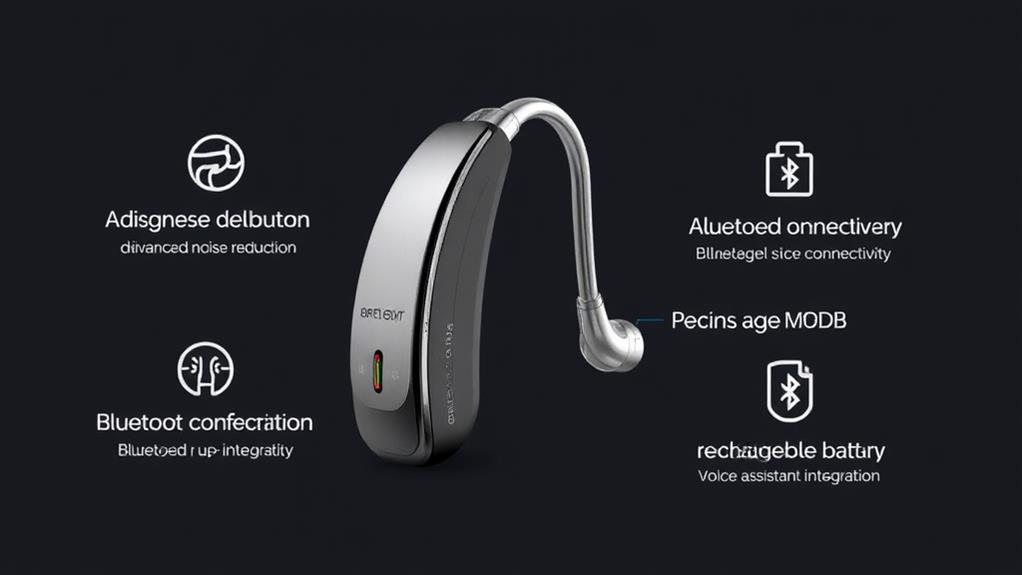
As you navigate the world of digital hearing aids, you’ll discover revolutionary features that transform your listening experience. You’ll enjoy automatic volume adjustment, which adapts to environmental noise, eliminating the need for manual control. Directional microphone technology enhances speech clarity in noisy settings, while advanced noise reduction suppresses disruptive sounds. Real-time language translation breaks down communication barriers, and adaptive listening programs personalize sound settings based on your preferences. These innovations greatly improve overall hearing quality, but there’s more to explore. Let’s explore these cutting-edge features and see how they can enhance your daily life.
Key Takeaways
- Automatic Volume Adjustment: Automatically adjusts volume based on environmental noise levels, enhancing user convenience.
- Directional Microphone Technology: Amplifies sounds directly in front while reducing background noise for clearer speech in noisy environments.
- Advanced Noise Reduction: Identifies and suppresses disruptive background noises effectively, ensuring a clearer sound experience.
- Real-Time Language Translation: Provides instantaneous translation for multilingual communication using advanced speech recognition technology.
- Adaptive Listening Programs: Employs AI to learn user preferences for personalized settings, optimizing sound quality in different environments.
Automatic Volume Adjustment
Frequently, one of the most significant challenges for hearing aid users is managing volume levels in different environments. You’re trying to enjoy a quiet dinner, but the background noise in the restaurant is overwhelming. Or, you’re watching TV at home, but the commercials are blaring. This is where automatic volume adjustment comes in – a game-changer for those with hearing aids.
With this feature, your hearing aids can automatically adjust the volume based on the environment you’re in. No more fiddling with user-friendly controls or worrying about missing out on conversations. Some hearing aids even integrate with your smartphone, allowing you to make adjustments on the fly. Imagine being able to seamlessly switch between a quiet meeting and a noisy coffee shop without having to manually adjust your hearing aids.
This feature is a lifesaver for those who struggle with volume management. No more straining to hear or getting blasted by loud noises. With automatic volume adjustment, you can focus on what matters – enjoying life without the hassle of constant volume adjustments.
Directional Microphone Technology
Directional microphone technology is a key feature in modern hearing aids, allowing you to focus on the sounds that matter most. This tech helps you tune in to conversations in noisy environments by amplifying the sound in front of you and reducing background noise. It’s like having a personal sound engineer who adjusts the volume and tone to optimize your listening experience.
The magic happens through clever microphone placement and sophisticated algorithms that analyze the sound environment. By positioning the microphones to capture directional sound, hearing aids can better separate speech from noise, making it easier for you to follow conversations. This feature is especially useful in restaurants, parties, or other loud gatherings where hearing can be a challenge.
With directional microphone technology, you’ll be able to hear your friends and family more clearly, even in the most chaotic environments. So, say goodbye to straining your ears and hello to effortless conversations. Your hearing (and your social life) will thank you.
Advanced Noise Reduction

Advanced noise reduction technology in hearing aids seamlessly integrates with directional microphones to enhance your listening experience in noisy environments. This means you can hear conversations more clearly, even in the most challenging situations like a busy restaurant or a loud party.
Noise reduction algorithms work by identifying and suppressing disruptive background noises, such as the hum of an air conditioner or the chatter of a crowd. This technology guarantees that the sounds you need to hear come through loud and clear, while unwanted noise is minimized. For example, if you’re at a dinner party and someone is talking to you, the noise reduction algorithm will amplify their voice while reducing the background chatter and clinking dishes.
This technology also helps with feedback cancellation, which is essential for avoiding that high-pitched whistling sound that can disrupt your listening experience. With advanced noise reduction, you get better sound clarity and less distraction, making it easier to focus on the conversations that matter.
Real-Time Language Translation
Real-time language translation is one of the most innovative features in modern digital hearing aids. Imagine being able to understand and communicate with people who speak different languages in real-time – it’s like having a personal translator in your ear!
This feature is made possible by advanced speech recognition technology that can detect and interpret multiple languages. Some high-end hearing aids offer multilingual support, allowing you to communicate with people who speak up to 27 different languages. The Thrive Hearing Control app and the My Audibel app are examples of cutting-edge technology that can translate languages in real-time, making it easier for you to travel, work, or socialize with people from diverse linguistic backgrounds.
With real-time language translation, you can focus on the conversation, not the language barrier. This feature is especially useful in noisy environments, where background noise can make it difficult to understand speech. By leveraging advanced algorithms and AI-powered technology, modern hearing aids can help you navigate complex listening situations with ease. So, whether you’re a world traveler or a language enthusiast, real-time language translation is a game-changer.
Adaptive Listening Programs

Building on the convenience of real-time language translation, adaptive listening programs take your hearing experience to the next level. Imagine having a personal audio assistant that adjusts to your surroundings, making sure you hear what matters most. This feature is all about making your hearing aids smarter and more intuitive.
Adaptive listening programs use AI to learn your user preferences and create personalized settings for different environments. For example, if you’re at a busy restaurant, your hearing aids can automatically switch to a setting that reduces background noise and focuses on the person speaking to you. It’s like having your own sound engineer, tweaking the settings in real-time to give you the best possible listening experience.
This feature is especially useful in dynamic environments where sound levels can change quickly. It’s like having a superpower that helps you navigate complex auditory situations with ease. With adaptive listening programs, you can say goodbye to fiddling with settings and hello to a more natural, effortless hearing experience. It’s time to level up your hearing game with this cutting-edge technology
Conclusion
You’ve got the lowdown on the top five cutting-edge digital hearing aid features. Now, it’s time to elevate your hearing game. With automatic volume adjustment, directional microphones, advanced noise reduction, real-time language translation, and adaptive listening programs, you can say goodbye to frustrating conversations and hello to effortless listening. Don’t let hearing loss hold you back – upgrade your hearing and transform your life.