If you're struggling with high-frequency hearing loss, you're not alone. Fortunately, various types of hearing aids can help you regain clarity in your daily conversations. Digital hearing aids, for instance, can be programmed to specifically amplify high frequencies, while options like Receiver-in-the-Ear (RITE) aids allow natural low frequencies to pass through while amplifying the highs. Behind-the-Ear (BTE) models offer advanced noise reduction features, and Completely-in-the-Canal (CIC) aids provide a discreet fit. But which one is right for you? Let's explore the details to find the perfect fit for your needs.
Key Takeaways
- Digital hearing aids are the most common type for high-frequency hearing loss, offering tailored sound amplification and noise reduction features.
- Receiver-in-the-ear (RITE) hearing aids are particularly effective, as they amplify high frequencies without blocking natural low frequencies.
- Behind-the-ear (BTE) hearing aids are versatile and suitable for various degrees of high-frequency hearing loss, offering wireless connectivity and advanced noise reduction.
- In-the-ear hearing aids provide a discreet fitting and can be customized for comfortable wear, often featuring directional microphones and Bluetooth connectivity.
- Completely-in-the-canal hearing aids offer a nearly invisible design for mild to moderate high-frequency hearing loss, enhancing sound clarity with a natural hearing experience.
Types of High-Frequency Hearing Aids
For individuals struggling with high-frequency hearing loss, there are several types of hearing aids designed to address this specific challenge. You're not missing out on the whole conversation, just the high-pitched parts that make words like "bash" and "bath" sound different.
Digital hearing aids are your best bet for addressing high-frequency loss. They're not just about making everything louder; they're about sound amplification tailored to your needs. For instance, receiver-in-the-ear (RITE) hearing aids with a dome are great because they don't block the low-frequency sounds you can still hear naturally. Instead, they amplify only the high-frequency sounds you struggle with, making conversations clearer. Many modern hearing aids also come with advanced noise reduction features, allowing you to focus on conversations even in noisy environments.
There are also behind-the-ear (BTE) models and completely-in-canal (CIC) hearing aids, each with its own set of benefits. BTE hearing aids are versatile and can help people of all ages and types of hearing loss, while CIC hearing aids are nearly invisible and work well for mild to moderate hearing loss. Whichever you choose, the goal is to help you hear more clearly, especially in noisy environments or when trying to understand speech.
Behind-the-Ear Hearing Aid Options
Behind-the-ear (BTE) hearing aids offer a versatile solution for high-frequency hearing loss, capable of assisting people of all ages and various degrees of hearing impairment. These devices are suitable for mild to profound hearing loss and are comfortable to wear. One of the main advantages of BTE hearing aids is their wireless connectivity, which allows for streaming from phones, TVs, and computers, enhancing your auditory experience. Advanced noise reduction features also make these devices ideal for maintaining clear sound in various environments. However, one potential drawback is their size, which can feel bulky for some users.
Despite their larger size, BTE hearing aids often have better battery longevity compared to smaller models. This is a significant advantage, especially for people who use their hearing aids extensively throughout the day. When choosing a BTE hearing aid, consider the level of your high-frequency hearing loss and your lifestyle needs. It is crucial to consult with an audiologist to guarantee the device suits your specific requirements. With the right BTE hearing aid, you can improve your ability to hear high-frequency sounds and enhance your overall hearing experience.
In-the-Ear Hearing Aid Models
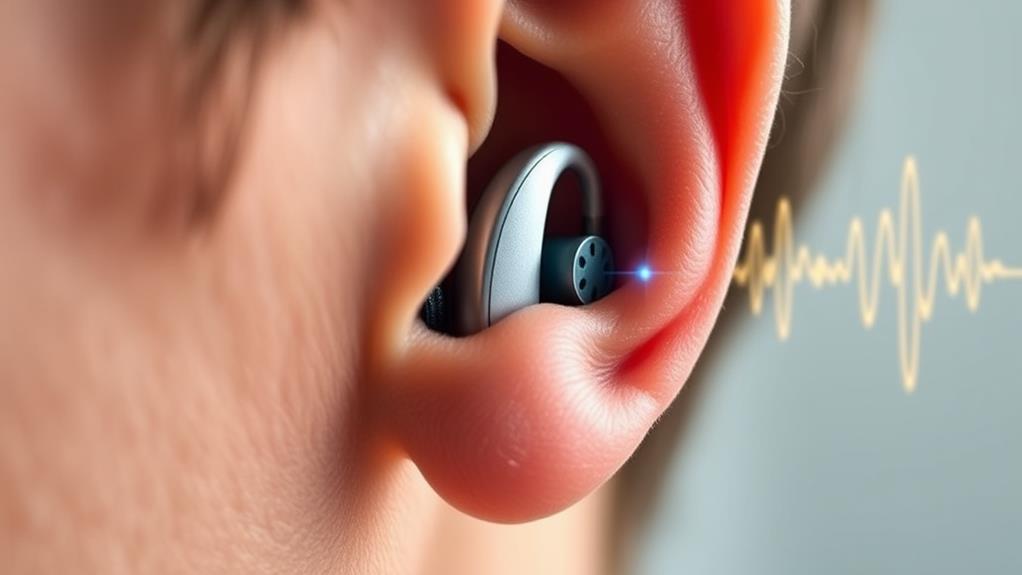
In-the-ear (ITE) hearing aids are designed to fit snugly within your ear, offering a discreet solution for mild to severe hearing loss. They come in two styles: full shell and half shell, which are custom made to fit your ear's shape and size. The full shell model fills most of the bowl-shaped area of your outer ear, while the half shell model fills only the lower part. Both are great for people with mild to severe hearing loss and can come with directional microphones for better hearing in noisy environments. Additionally, some ITE hearing aids offer Bluetooth connectivity for seamless integration with smartphones and other devices, enhancing the overall user experience.
When it comes to battery life, ITE hearing aids are generally smaller, so they might not last as long as behind-the-ear models. However, they are still durable and can provide a range of features to improve your hearing. The fitting process is vital to guarantee comfort and effectiveness. An audiologist will help you choose the right model and adjust it to fit your ear perfectly. With a proper fit, you'll be able to hear more clearly and comfortably, making a big difference in your daily life. Plus, ITE hearing aids are pretty stylish, so you won't have to worry about them being too noticeable.
Receiver-in-the-Canal Hearing Aids
Receiver-in-the-Canal (RIC) hearing aids offer a unique combination of discretion and functionality. Behind your ear sits the main device, and a thin wire connects it to a small receiver in your ear canal. This style is perfect for those with high-frequency hearing loss as it amplifies these sounds while allowing low-frequency sounds to enter the ear naturally.
You might be wondering how this works. Think of it like this: say you're having trouble hearing the hissing sound in "shed" or the sharp "t" in "tap". A RIC hearing aid can pick up these high frequencies and deliver them directly into your ear, making speech clearer. Plus, because the ear canal remains open, sound quality is often described as more natural.
User comfort is also a big win with RICs. They're generally easier to adjust and remove compared to completely in-the-canal models, and many users find them more comfortable to wear. So, if you're looking for a balance of aesthetics and functionality, Receiver-in-the-Canal hearing aids could be your best bet for tackling high-frequency hearing loss.
Completely-in-the-Canal Hearing Aids
Completely-in-the-Canal (CIC) hearing aids offer a discreet and custom-fit solution for those with mild to moderate hearing loss. These tiny devices are perfect for you if you're looking for a hearing aid that's almost invisible. They fit snugly inside your ear canal, making them super discreet and cosmetically appealing. Plus, they're great for enhancing sound clarity.
- They're custom-made to fit your ear perfectly, providing great sound quality.
- They're ideal for you if you've got mild to moderate hearing loss.
- You'll enjoy a more natural hearing experience since they sit deep within your ear canal.
- They're a fantastic choice for those who want a minimalist approach to hearing aids.
While CIC hearing aids are super effective for high-frequency loss, they do require some manual dexterity to handle and might not be suitable for everyone. But if you're looking for a discreet and effective solution, CIC hearing aids are definitely worth considering. Just remember, they might need a bit more maintenance than other types, but they're worth it for the sound clarity and custom fitting they provide.
Conclusion
You're dealing with high-frequency hearing loss? Don't worry, there are hearing aids that can help For high-frequency hearing loss, digital hearing aids are your best bet. They can amplify specific frequencies, making it easier to hear high-pitched sounds. Behind-the-Ear (BTE) models are versatile with advanced noise reduction, while Completely-in-the-Canal (CIC) aids are super discreet. Consult an audiologist to find your perfect match. Get the right hearing aid, and you'll be tuning back in no time